eToro Crypto Review: Handy Next to Your Stocks, Costly as a Place to Hold Crypto
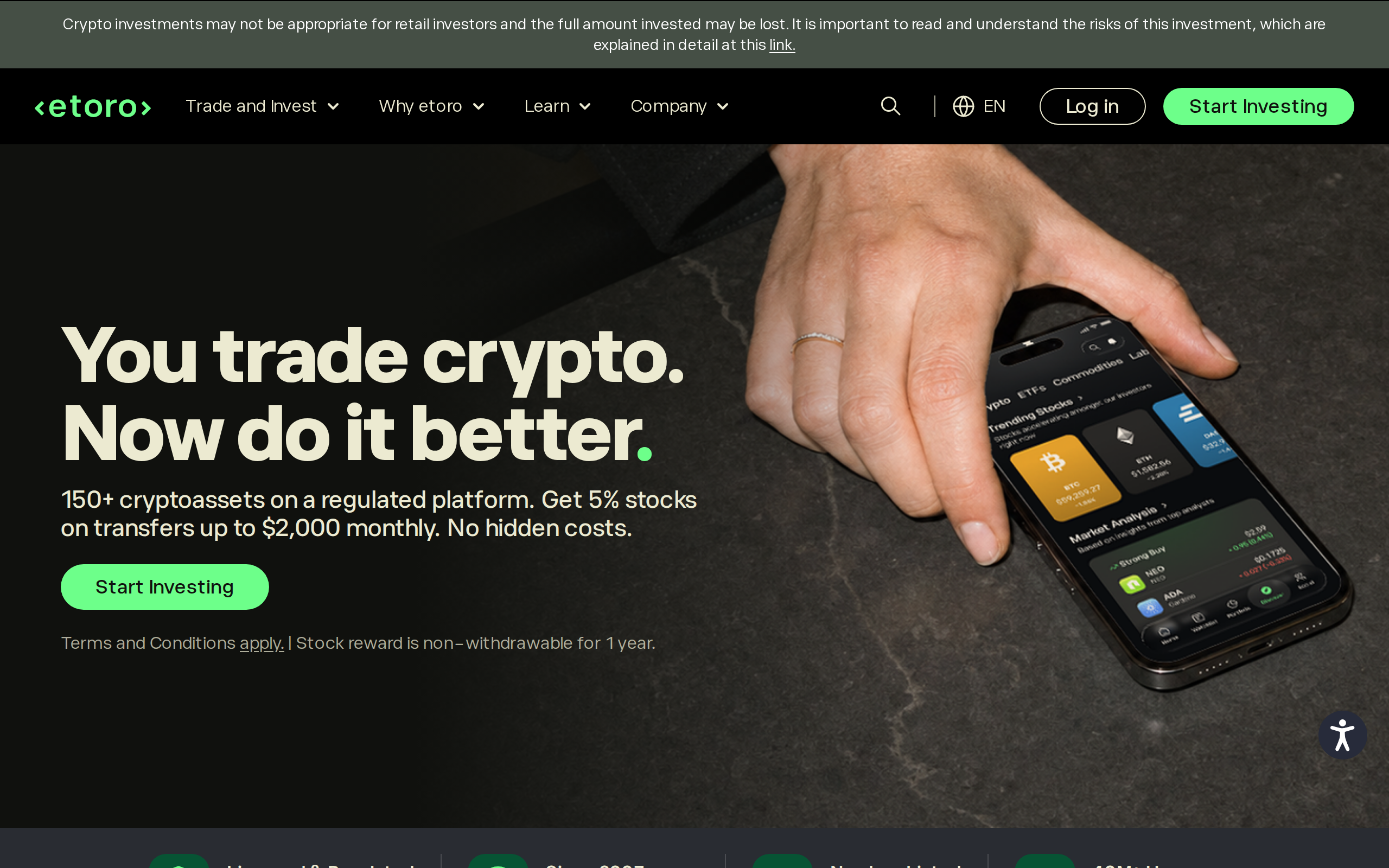
eToro lets you buy 150+ coins beside shares in one regulated app, but charges 1% a trade, 2% to move coins to its wallet and keeps staking rewards. We tested what that means for crypto-first readers.
The verdict
eToro is a reasonable way to own some crypto if you already invest in stocks there and want one regulated login. As a crypto home it is expensive: 1% on every manual trade, 2% to move coins to its wallet, and only seven coins can be moved there at all. Crypto also has no compensation scheme, so we would not keep much on it.
Best for Stock investors adding a small crypto position
Pros
- Crypto, stocks and ETFs in one regulated app with one login
- Regulated by the FCA, CySEC with a MiCA licence and other authorities
- Staking for 11 assets, with no lock-up period
- Clear fee table, with the fee shown before you confirm a trade
Cons
- 1% fee on manual crypto trades at the Bronze, Silver and Gold levels
- 2% fee to transfer coins to the eToro Money wallet, and the move is one way
- Staking pays 45% to 90% of rewards, depending on Club tier
- Crypto holdings are outside the FSCS and ICF compensation schemes
Most people who buy crypto on eToro did not come for crypto. They came for shares, ETFs or copy trading, saw Bitcoin in the same app and tapped it. That is a perfectly good way to start. It is a poor way to keep going, because eToro's pricing is built for convenience and not for coins you plan to hold or move.
Our test followed that path: a funded account, a few manual buys, a staking opt-in and a look at what it takes to get coins out. The pattern was consistent. Buying is easy, and leaving is where it costs.
The 1% that sits on every trade
The fees page states that manual crypto trades cost a flat 1% at the Bronze, Silver and Gold Club levels. Higher tiers get a discount that depends on monthly volume: 0.95% to 0.70% at Platinum, 0.90% to 0.50% at Platinum+, and 0.85% to 0.30% at Diamond. The charge is calculated at the end of each month and excludes CFDs, Smart Portfolios and CopyTrader.
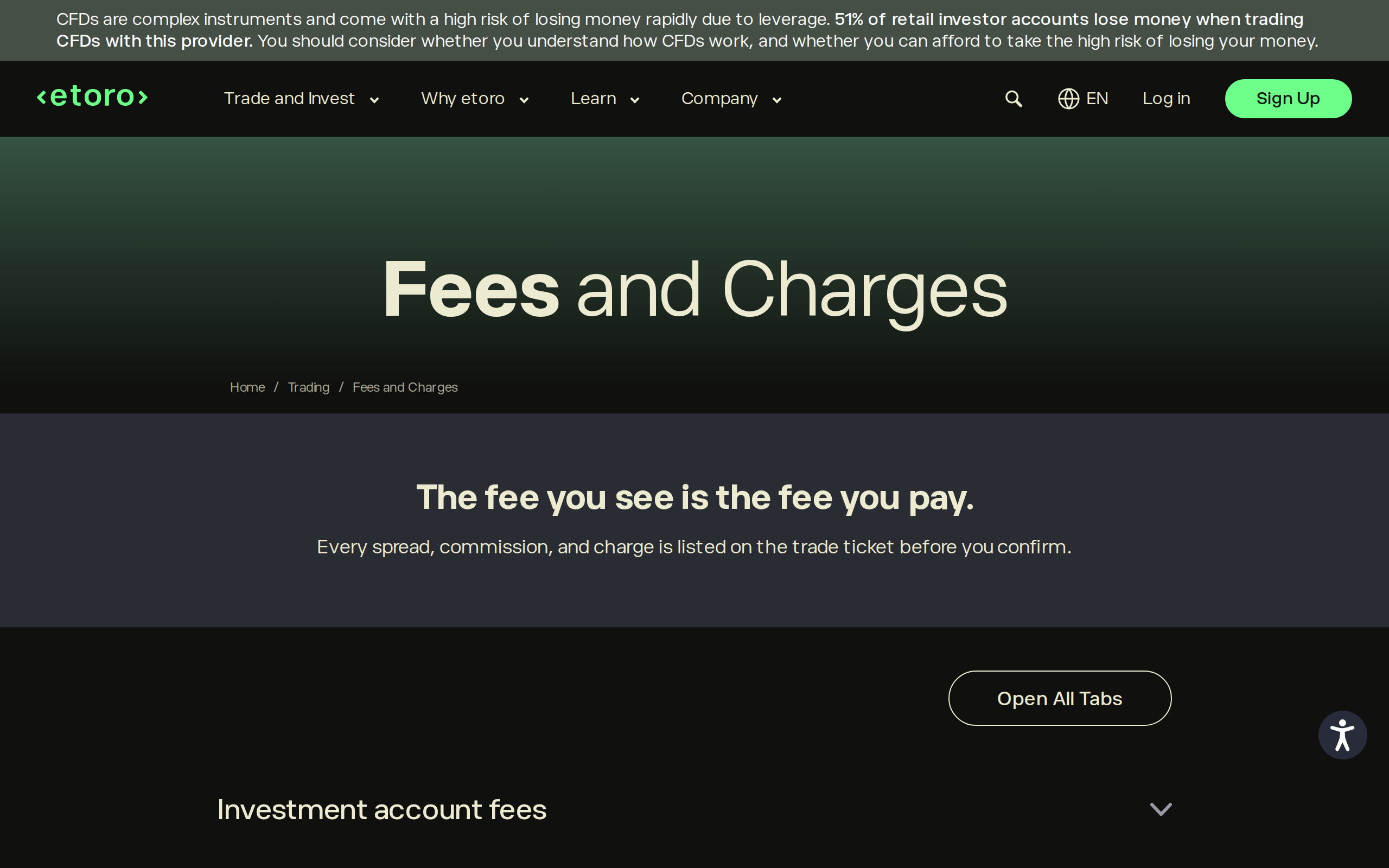
A 1% fee on a $1,000 purchase is $10, and you pay it again when you sell. Compare that with the 0.10% base spot fee at Binance, which our Binance review covers. The market spread is a separate cost that eToro says it does not charge but that still moves your fill price. For a one-off $500 purchase this is tolerable. For monthly buying, or trading in and out, it adds up fast.
Getting coins out is the expensive part
Crypto bought on the trading side stays on the platform unless you move it. The route out is the eToro Money wallet, and eToro charges 2% to transfer coins into it, according to its fee table. Third-party reviewers add a $1 minimum and a $100 maximum on that charge, and say only seven coins (Bitcoin, Bitcoin Cash, Ethereum, Litecoin, Stellar, Tron and XRP) can be moved at all, per Blockport. The transfer cannot be reversed back to the trading account.
Add the smaller frictions: a $5 fee for a USD withdrawal and a $10 monthly inactivity fee, both reported by Blockport and worth confirming in your own account. New U.S. users initially trade only a short list of coins, and availability differs by state and country.
So the honest framing is this. eToro is a place to hold crypto exposure, not a place to hold coins you want in your own wallet. If self-custody matters to you, buy elsewhere. Our Coinbase review covers a pricier but more conventional alternative.
Staking: where the platform keeps a large share
The staking page lists 11 assets, among them Ethereum, Solana, Cardano and Polkadot. There is no lock-up, rewards arrive monthly and the minimum reward is 1 USD. The catch is the split: you receive 45% of the yield at Bronze, rising to 55%, 65%, 75%, 85% and 90% as you climb to Diamond.
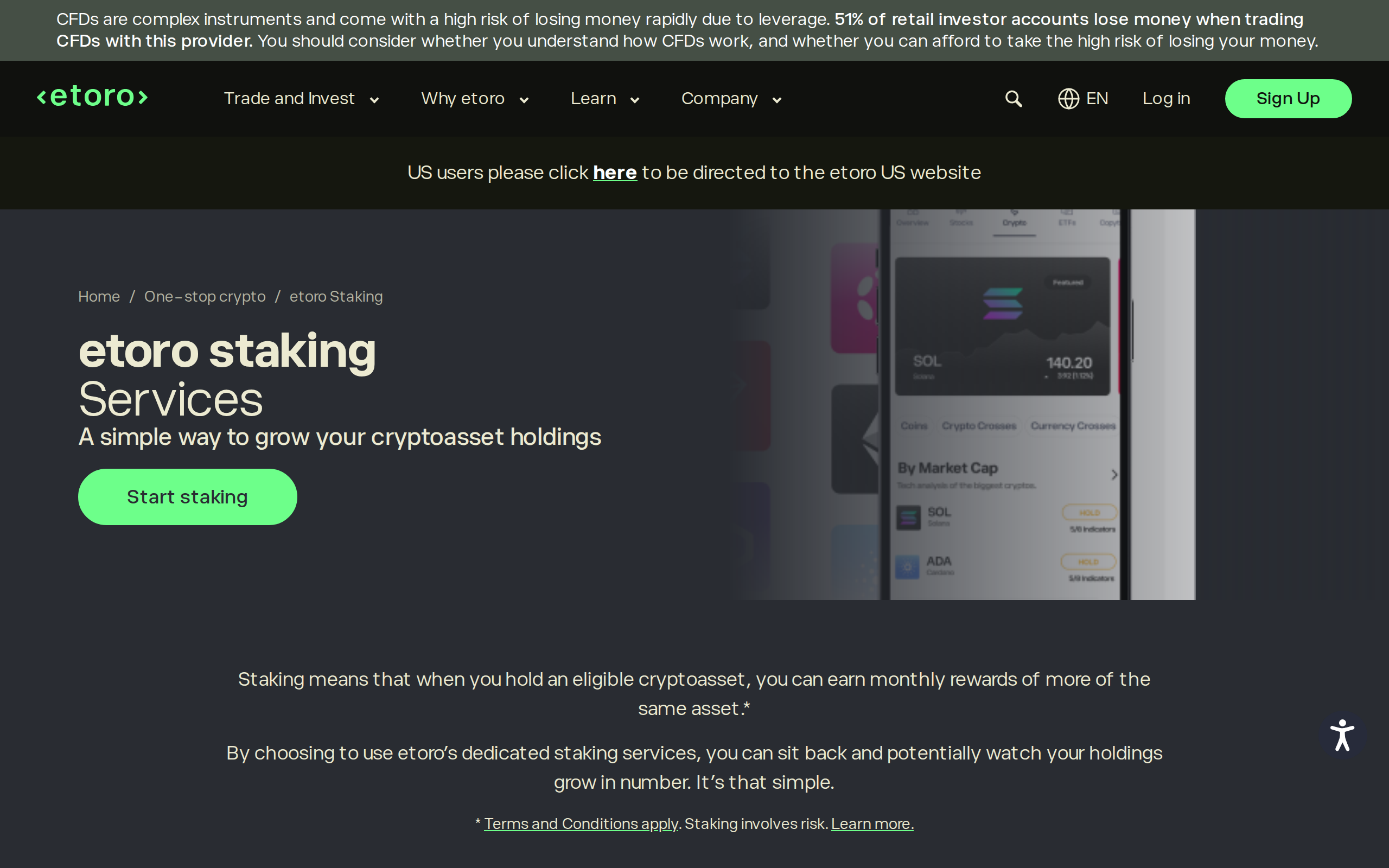
A Bronze user therefore gives away more than half of what the protocol pays. For comparison, staking in a self-custody wallet usually keeps far more of the reward, with more setup work.
Regulation and what it does not cover
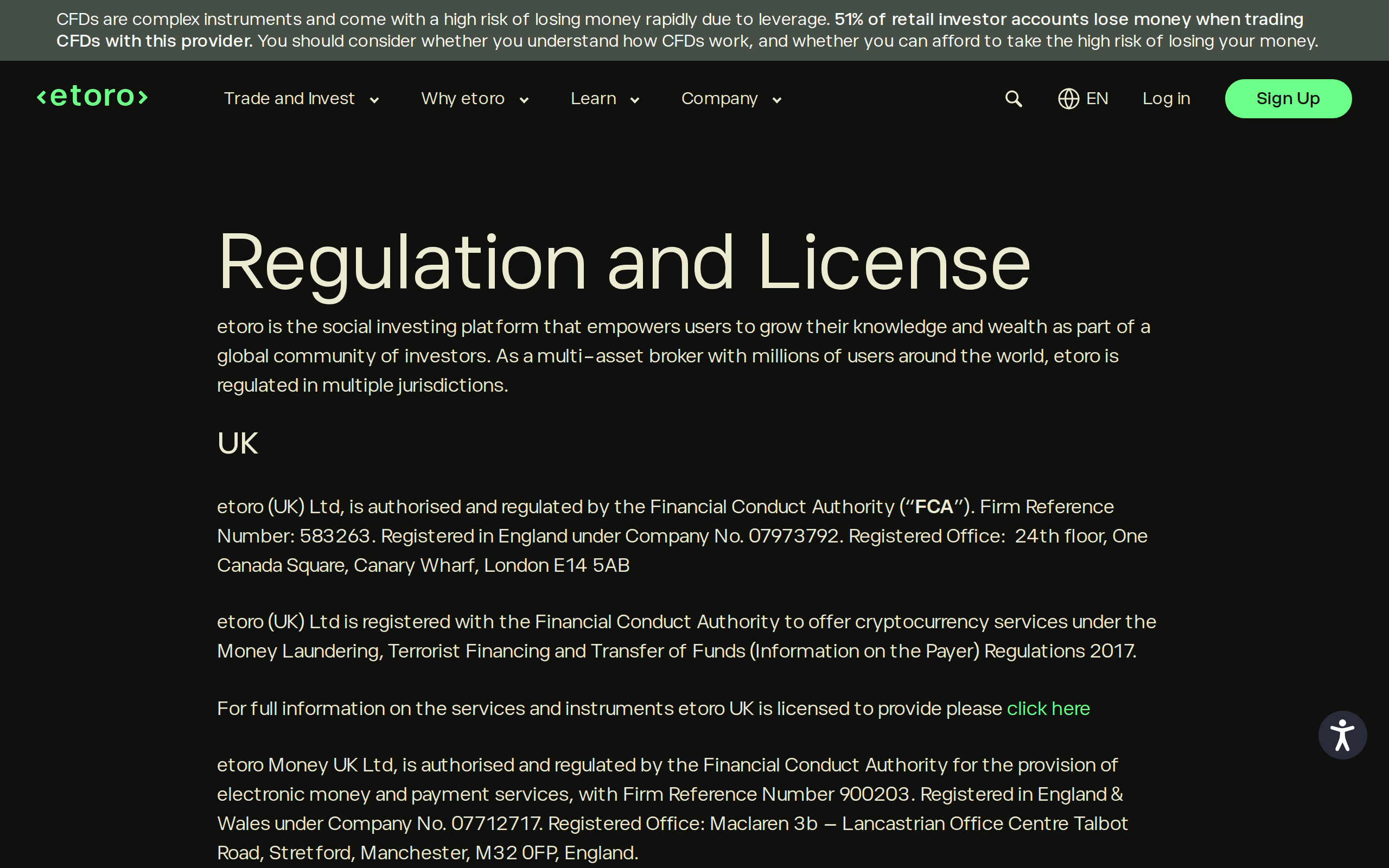
eToro's licence page lists a spread of regulators: the FCA for eToro (UK) Ltd (reference 583263), CySEC for eToro (Europe) Ltd with a MiCA licence granted in January 2025, ASIC in Australia, MAS in Singapore, and FinCEN, SEC and FINRA registrations in the United States. That is a better record than most crypto-only venues, and it matters if a regulated broker is your requirement.
Read the protection page before you rely on that, though. It says funds sit in segregated accounts with major banks, but also that crypto trading does not qualify for the compensation schemes (the ICF in Cyprus or the FSCS in the UK). Private insurance of up to 1 million applies to larger balances.
Who should use it
Use eToro crypto if you already hold stocks there, want a small position in a few big coins and value one regulated login over the cheapest price. The 150+ coin menu on the crypto page is generous, though what you see depends on where you live.
Skip it if you trade often, want to withdraw to a wallet, or plan to stake in size. This is not advice on whether to buy any asset, and crypto can fall to zero. We rate it 6.2 as a crypto home, and higher as a stock broker with a crypto shelf.
Specifications
- Crypto fee
- 1% per manual trade (Bronze, Silver, Gold)
- Lower fee tiers
- 0.30% to 0.95%, Platinum to Diamond, by volume
- Wallet transfer
- 2% to eToro Money, $1 minimum, $100 maximum
- Staking share
- 45% (Bronze) up to 90% (Diamond) of rewards
- Stakable assets
- 11, including ETH, SOL, ADA and DOT
- Coins offered
- 150+ (eToro page); varies by country
- Compensation cover
- Not for crypto; private insurance up to 1M on larger balances
- Regulators
- FCA (UK), CySEC (EU, MiCA), ASIC, MAS, FinCEN (US)
As published by eToro when we tested it.