Bitvavo Review: Cheap, MiCA-Licensed and Euro-First, With Few Tools Beyond Spot
Bitvavo charges 0.15% maker and 0.25% taker at its base tier, holds a Dutch MiCA licence, and takes SEPA and iDEAL free. It offers no futures or margin, and support is email only.
The verdict
For a European who wants to buy and hold crypto with euros, Bitvavo is one of the cheapest regulated options: a 0.15% maker and 0.25% taker base fee, free SEPA and iDEAL deposits, and a Dutch AFM licence under MiCA. It is spot only, support is by email, and card funding costs extra. Active traders who need margin or futures will outgrow it, and readers outside the EEA cannot open an account.
Best for Euro-based European buyers who want low spot fees under a MiCA licence
Pros
- Base spot fees of 0.15% maker and 0.25% taker, falling with 30-day volume
- Holds a MiCA CASP licence from the Dutch AFM, passported across the EEA
- SEPA and iDEAL deposits are free, and euro is the home currency
- Around 400 assets on a clean Assets page with gainers and losers
- Account Guarantee covers up to EUR 100,000 of unauthorised activity if you meet its terms
Cons
- Spot only: no futures, margin or derivatives for active traders
- Support runs by email and contact form, with no 24/7 live chat
- Card and PayPal deposits carry a percentage fee, unlike bank transfers
- Standard withdrawal ceiling is EUR 25,000 per 24 hours, euro and crypto combined
- Available only to residents of supported European countries
Bitvavo is the exchange to look at first if you live in Europe, think in euros, and mostly want to buy a handful of coins and leave them alone. It is cheaper than most regulated rivals at its base tier, it holds a MiCA licence, and its deposit routes suit European banks. It is a poor fit for anyone who wants leverage, and a closed door for anyone outside the EEA.
The licence is the real headline
Many exchanges spent 2025 working out how to stay in Europe. Bitvavo's route was direct. The Dutch regulator, the AFM, granted it a MiCA crypto-asset service provider authorisation on 27 June 2025, according to CoinCodeCap's review, and that authorisation can be passported across the European Economic Area. The firm also published its own MiCA explainer for customers.
What does a licence change for you? It sets rules on how the company holds client assets, discloses risks and handles complaints. It does not insure your coins against a price fall, and it does not make the platform hack-proof. We treat it as a floor, and Bitvavo clears that floor, which is more than we can say for several larger names we have covered.
What a trade costs
The fee page bases your rate on your trading volume over the previous 30 days, across all crypto markets. A new customer starts in the first band, which covers volume from EUR 0 and is posted at 0.15% for makers and 0.25% for takers. The bands then step up through EUR 100,000 and EUR 250,000, and each step lowers the rate.
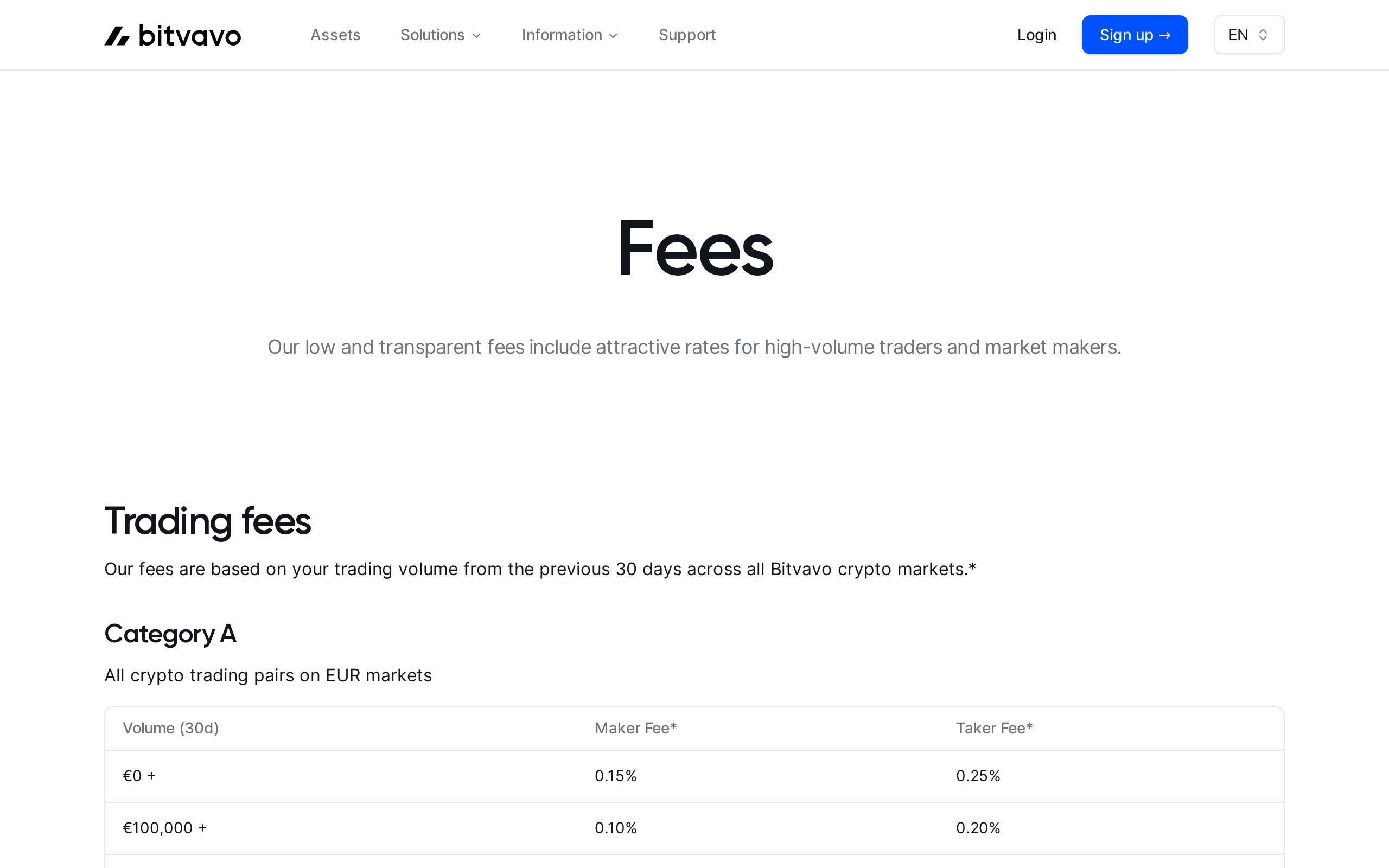
A maker order rests on the book and waits for a counterparty. A taker order fills at once. If you place a limit order at a price slightly below the market and wait, you pay the lower rate. If you tap Buy and accept the market price, you pay 0.25%. On a EUR 1,000 purchase that is EUR 2.50 against EUR 1.50, a gap that matters only if you buy often.
Funding is where costs can sneak in. SEPA bank transfers and iDEAL are free, per the review's deposit table. Cards and PayPal carry a percentage fee that sources put at roughly 1% or more, so a card top-up can cost several times what the trade itself does. Use a bank transfer and the problem disappears.
Limits that shape how you use it
Deposits are generous: iDEAL goes up to EUR 50,000 per transaction and SEPA up to EUR 1 million, as reported by comparison sites. Withdrawals are tighter. Bitvavo's help centre sets a standard ceiling of EUR 25,000 per 24 hours, counted across euro and crypto together. Most readers will never touch that. A business moving a large sum will need to raise it through further verification, and should plan for the delay.
Bitvavo has no futures, margin or derivatives desk. We see this as a feature for a buy-and-hold reader: fewer buttons that can lose you money quickly. For a trader it is a hard stop.
What you can buy
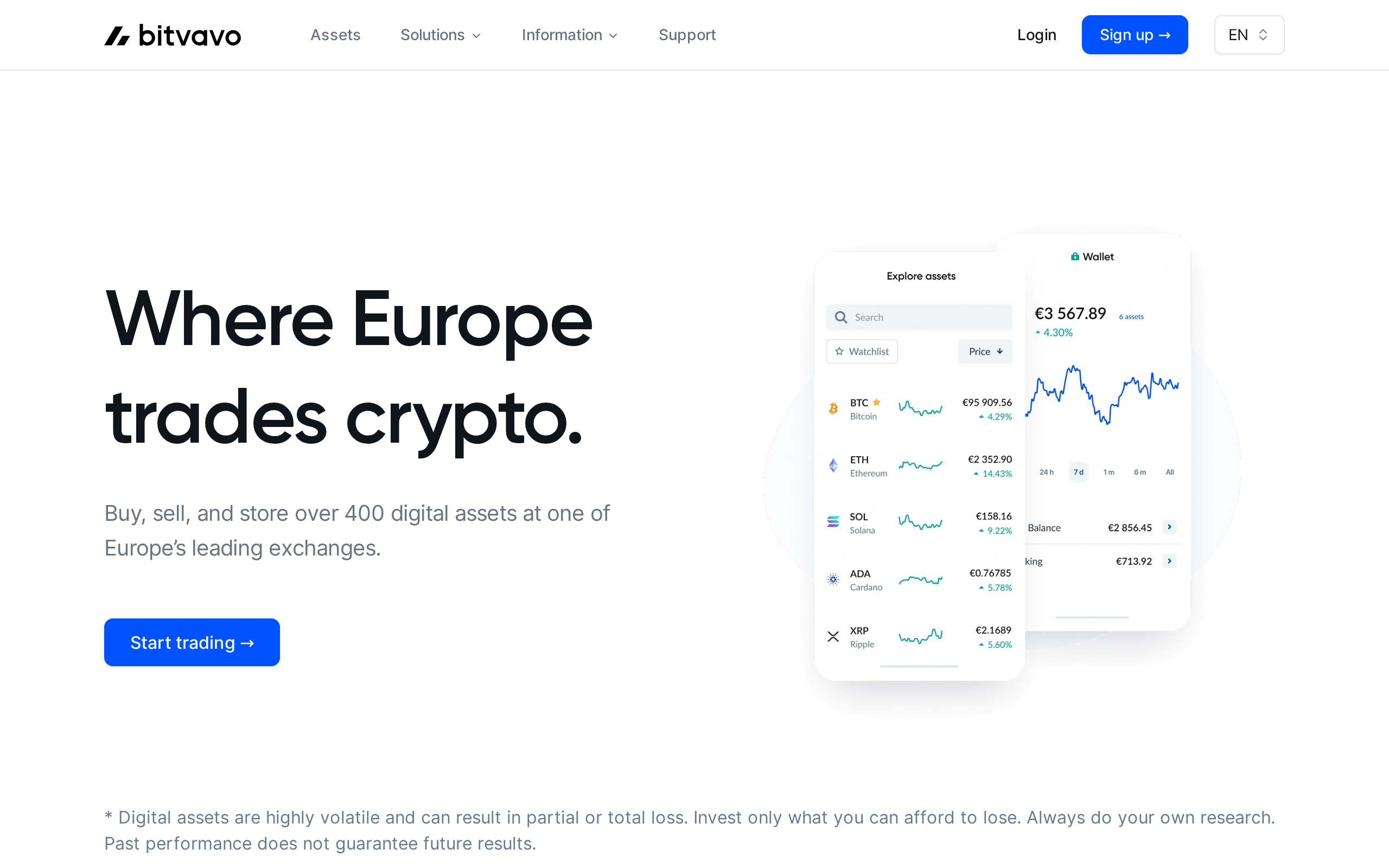
The Assets page says you can buy and sell more than 400 digital assets for euros, with overview, top gainers and top losers tabs.
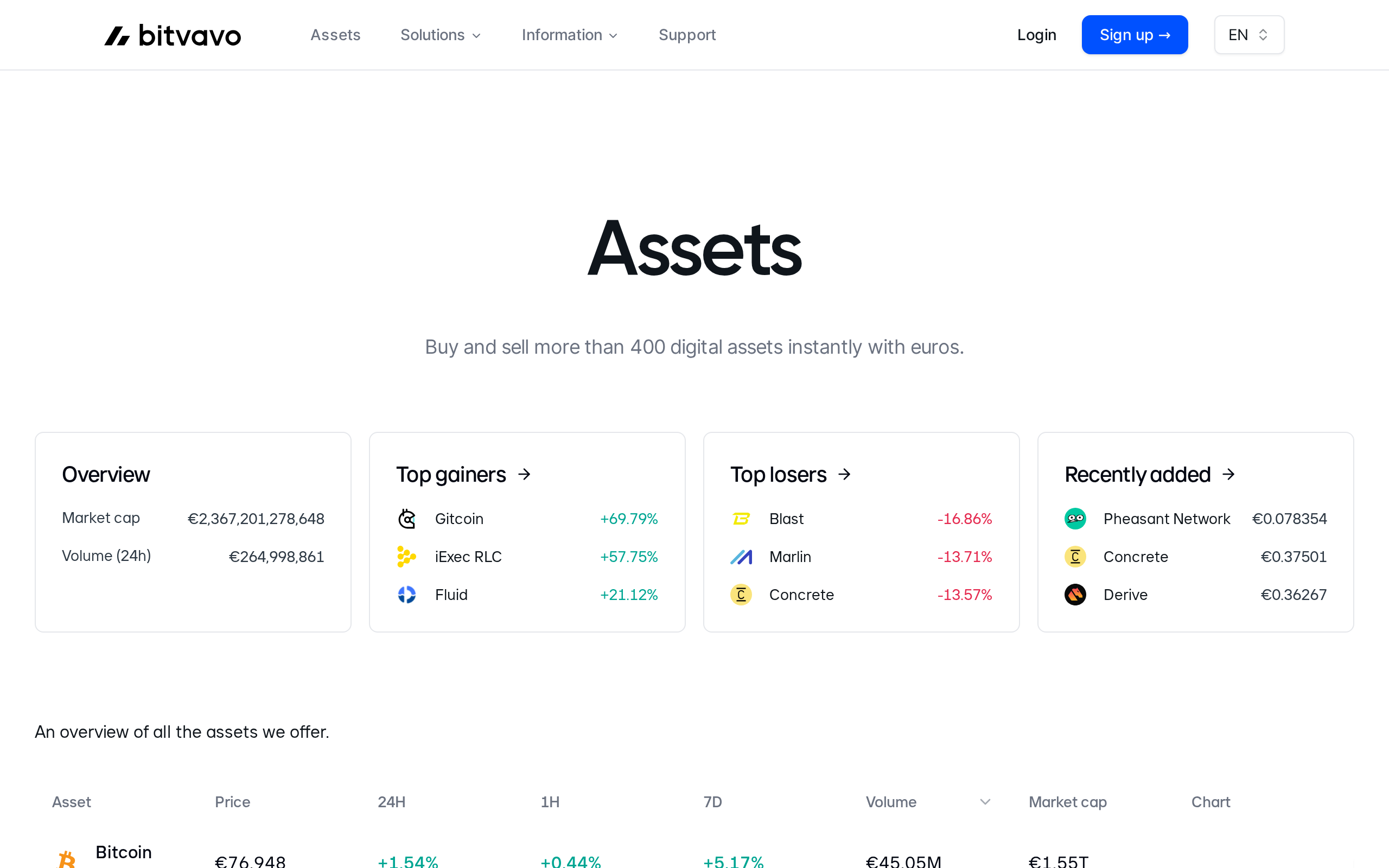
That is fewer than the biggest global exchanges, which list thousands. It is also an advantage. A shorter list means less junk, and the major coins, stablecoins and the better-known altcoins are all present. If your target is a micro-cap that launched last week, look elsewhere, and treat that as a warning about the token as much as about Bitvavo.
Staking is available too, with yields that sources describe as ranging from near zero to double digits by asset. Yields move, so read the rate on screen before you commit, and remember that a high number on a volatile asset is a risk label rather than a gift.
Safety, support and the small print
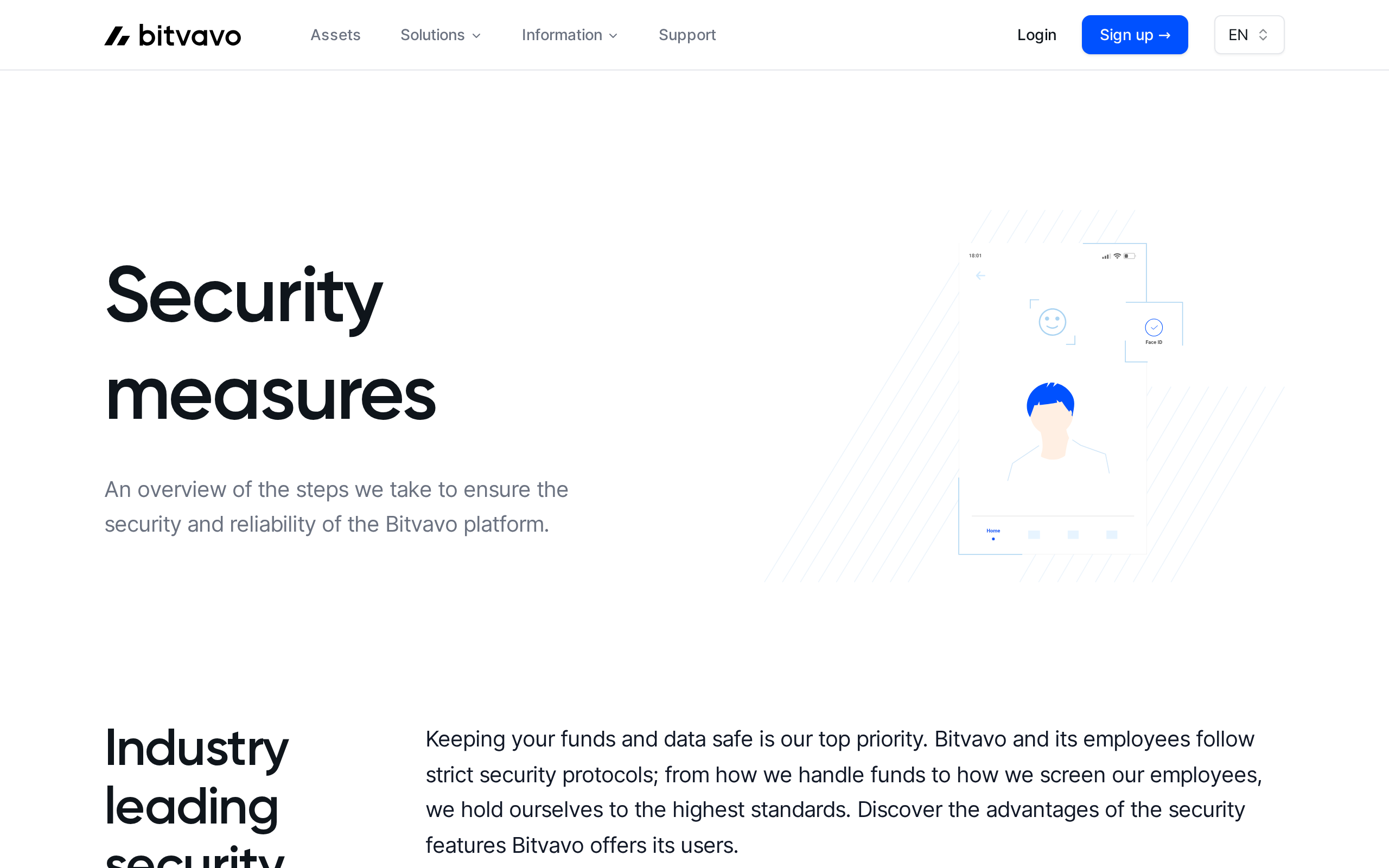
On custody, the platform's security page describes industry-standard protections.
Third-party reviews add that most client assets sit in cold storage with institutional custodians, and that an Account Guarantee covers up to EUR 100,000 of unauthorised activity if your account is at least 30 days old and has authenticator-app two-factor in place for the same period. Read those conditions before you rely on the guarantee, because a new account does not qualify.
Support is the weak spot. It runs by email and web form in Dutch and English, with no round-the-clock chat. When you are stuck mid-transfer on a weekend, that matters.
Who should open an account
Open one if you are an EEA resident, want a regulated place to buy Bitcoin, Ether and a few others with euros, and care about the fee on each order. Pay by bank transfer, use limit orders when you can, and move long-term holdings to a wallet you control.
Skip it if you want derivatives, a huge token menu, or a live-chat desk. Skip it too if you live outside Europe. Nothing here is advice about what to buy: crypto can fall sharply, and a licence does not change that.
Specifications
- Base spot fee
- 0.15% maker, 0.25% taker (EUR markets)
- Licence
- MiCA CASP, Dutch AFM, granted 27 June 2025
- Assets
- Around 400 digital assets
- Products
- Spot trading, staking and earn
- Free deposits
- SEPA and iDEAL
- Withdrawal limit
- EUR 25,000 per 24 hours (standard)
- Support
- Email and contact form
- Founded
- 2018, Amsterdam
As published by Bitvavo when we tested it.