dYdX Review: A Capable Perps DEX With Fair Fees, Now Living in Hyperliquid's Shadow
dYdX charges 5 bps taker and 1 bp maker at the entry tier on its own Cosmos chain. We checked the fee ladder, the markets list and the volume gap to Hyperliquid, and who still has a reason to pick it.
The verdict
dYdX is a mature, audited perpetuals exchange on its own chain, with a clear fee ladder and staker-paid fees. It is no longer the default. Third-party trackers show Hyperliquid doing in a week what dYdX does in a month, and the entry fee of 5 bps taker is higher than the leader's. Margin is USDC only and US users are blocked. Worth a look for BTC and ETH traders who value a large validator set.
Best for Experienced perp traders who want an audited chain and a staking fee discount
Pros
- Published fee ladder from 5 bps taker down to a 1.1 bp maker rebate at $200M volume
- Staking DYDX cuts fees by 25% to 50% at the lowest tier, and stakers earn trading fees
- Self-custody with no sign-up form: connect a wallet and deposit USDC
- Public codebase, audits by Informal Systems and a bounty up to $5 million, per Coin Bureau
Cons
- Far smaller than Hyperliquid, so liquidity on long-tail markets is thinner
- USDC is the only margin asset, and routing it in through Noble or IBC confuses beginners
- US users are restricted on the official interfaces, and VPN use is barred
- High leverage and fast liquidations make it unsuitable for new traders
dYdX was the decentralized perps exchange before there was a race. It started on Ethereum, then rebuilt itself as its own Cosmos chain, and it still runs that way: an order book kept by validators, with no company holding your funds.
The question in 2026 is not whether it works. It does. The question is why you would pick it when Hyperliquid has taken most of the volume.
The gap is bigger than the brand suggests
Third-party trackers tell one story. A comparison from Eco puts dYdX at about $40 billion to $60 billion in monthly perp volume. Another tally has Hyperliquid at $43.78 billion in the seven days to 3 October 2026. One week against a month is the order of magnitude.
Value locked tells the same tale: roughly $6 billion on Hyperliquid, against $300 million to $400 million on dYdX. These are third-party numbers, and trackers disagree on exact shares, so use them as a direction, not a measurement.
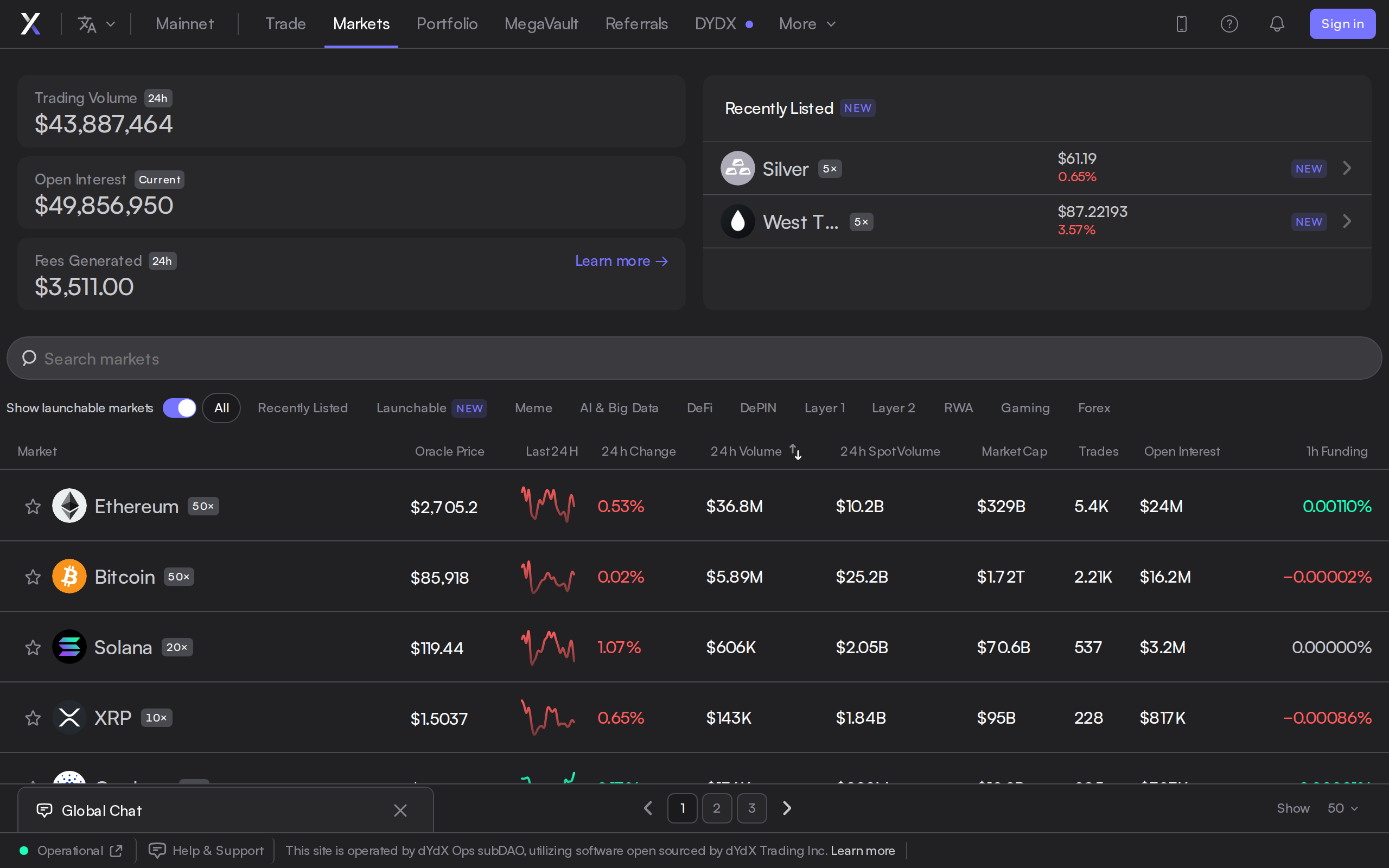
What it means in practice is depth. On BTC and ETH, dYdX is liquid enough. On smaller markets the book is thinner, and slippage costs more than the fee schedule suggests.
Fees: clear, but not the cheapest at the door
Fees are where dYdX is easiest to judge, because the schedule is public. At the entry tier, below $1 million of 30-day volume, you pay 5.0 basis points as taker and 1.0 as maker. That is 0.05% and 0.01%.
The ladder falls with volume: 3.5 bps taker and 0 maker at $25 million, 2.5 taker and a 0.7 bp rebate at $100 million, and a 1.1 bp rebate at $200 million.
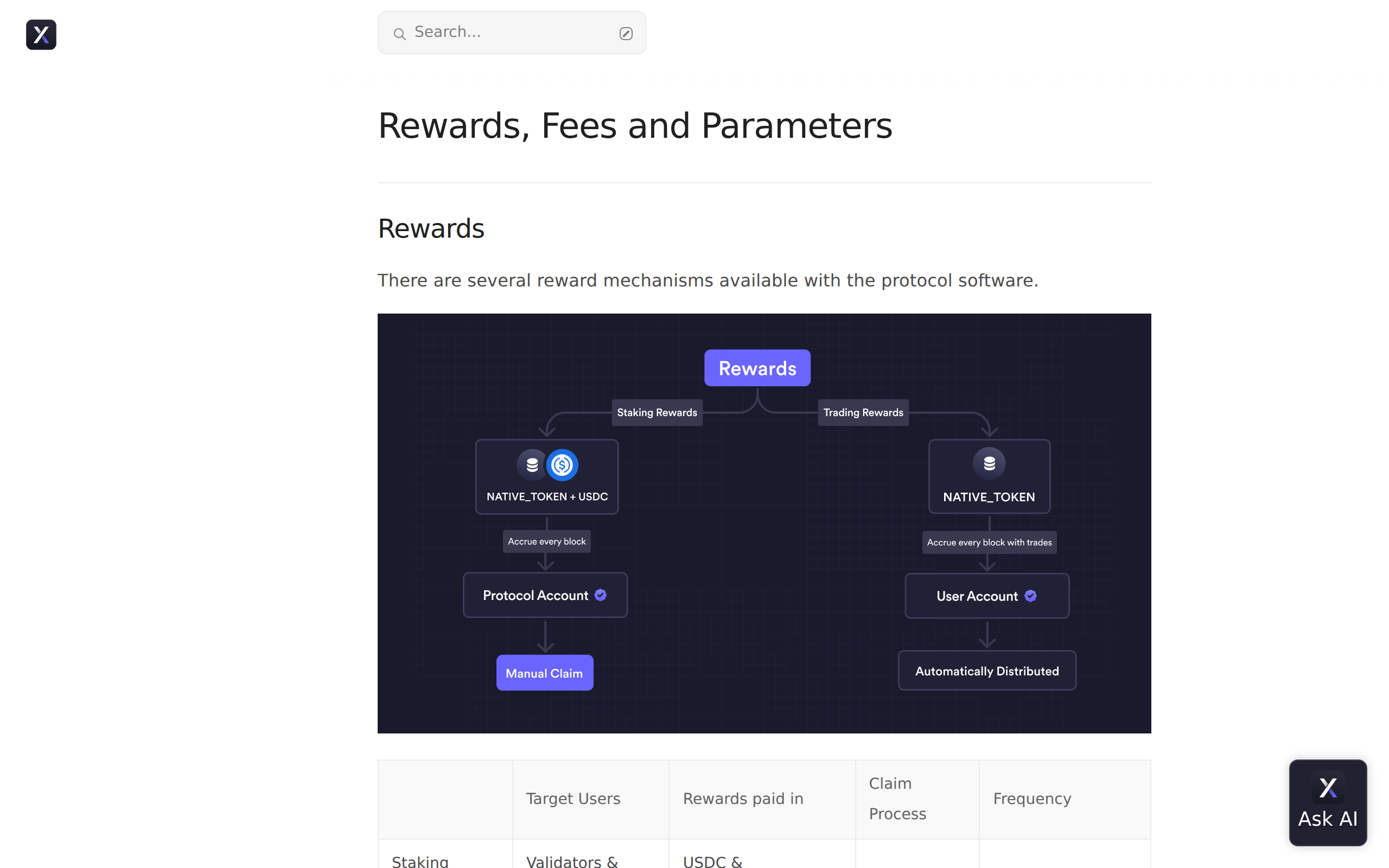
Staking changes the picture. A tier-1 trader staking 3,000 DYDX gets a 25% discount, and 20,000 DYDX gets 50%. Discounts apply to positive fees only, never to rebates. Fees also flow back to stakers and validators each block, minus a community tax and validator commission.
For a small trader that means about 5 bps if you do nothing. It is acceptable. Our point is that it leaves no price advantage over the leader, so fees alone will not draw you in.
Using it
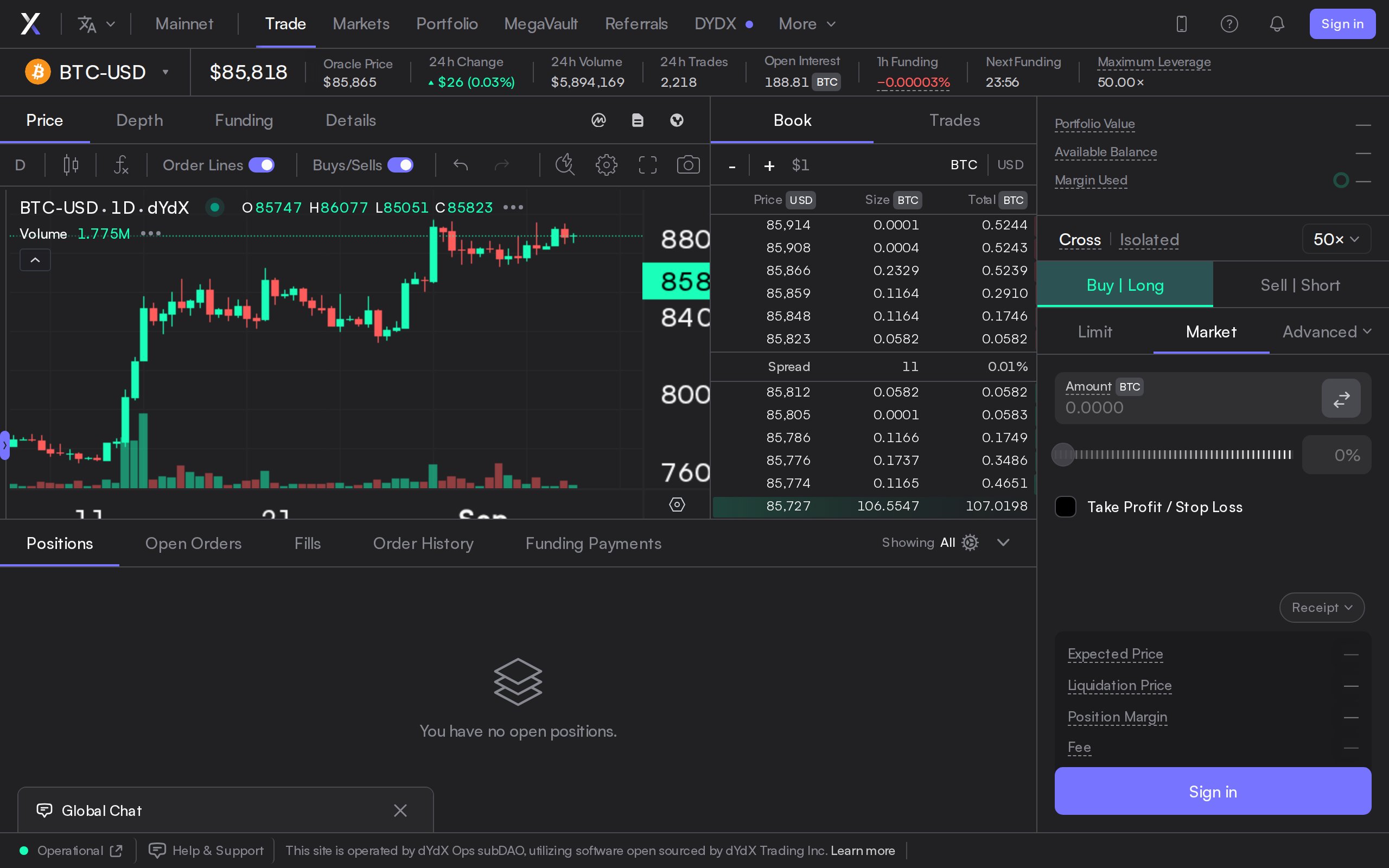
The trading screen is the standard pro layout: chart, order book, order ticket, positions.
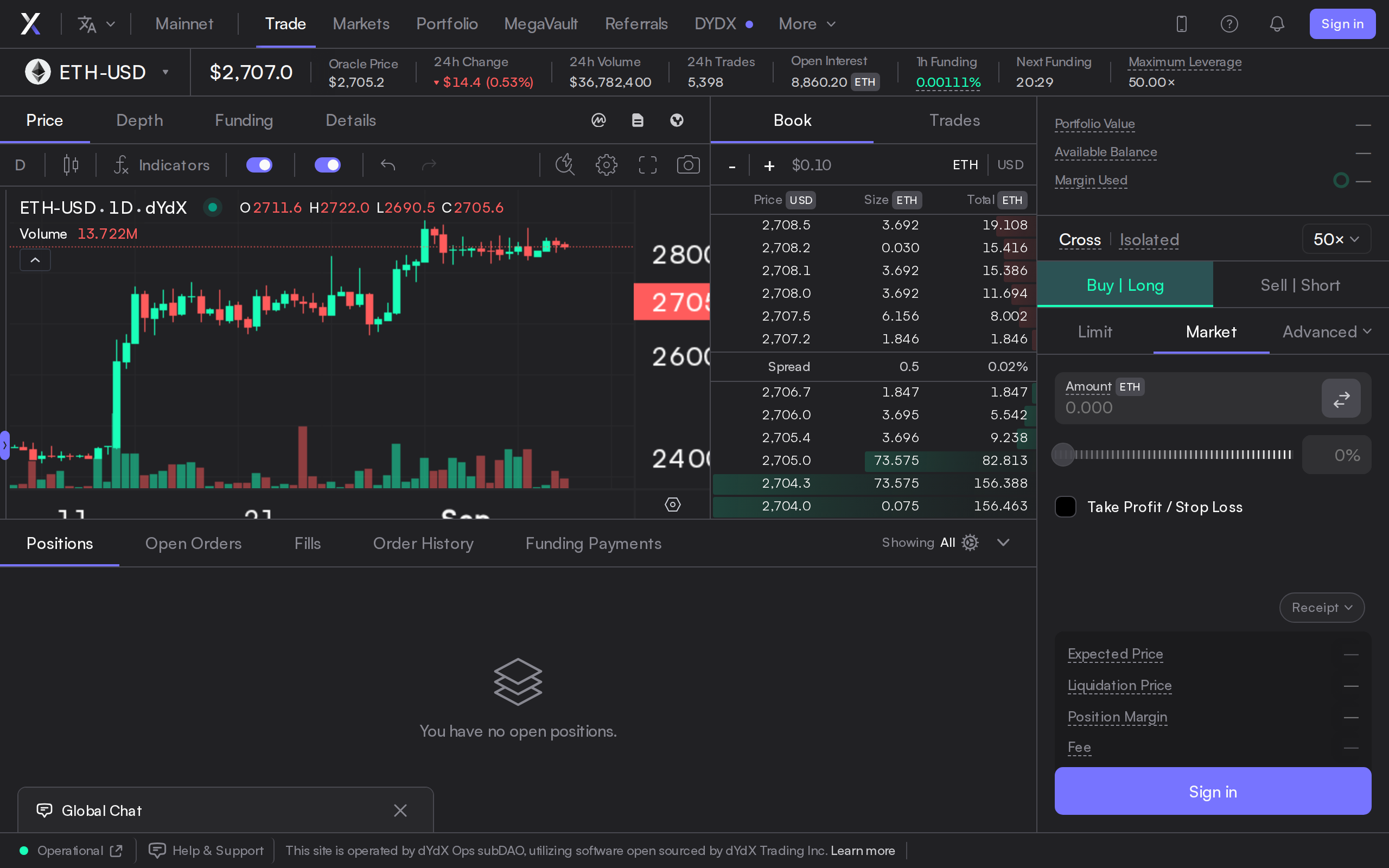
Order types include market, limit, stop-limit and take-profit. Leverage goes up to 25x on some markets according to Coin Bureau, and we would treat that as a ceiling you should not approach.
The friction comes before the first trade. Collateral is USDC only, and getting it onto the dYdX chain means a bridge or a transfer through Noble over IBC. Coin Bureau puts those transfers at $0.10 to $0.50 each, and instant routes at 10 bps unless waived. If you have only used a centralized exchange, expect an evening of reading.
There is no fiat on-ramp and no spot market. This is perpetual futures only, a product that liquidates losing positions automatically.
What the DYDX token is for
The token does two jobs. It secures the chain, since validators and stakers run consensus and are paid from trading fees plus gas fees, after the community tax and validator commission. It also buys fee discounts, which is why the staking table matters to active traders.
That ties your costs to a token price you do not control. If you stake 20,000 DYDX for a 50% discount and the token halves, the saving shrinks while the stake is still locked in. Check the unbonding period before committing, and work out what the discount is worth at your volume, not at the headline rate.
Safety and access
The code is public. Coin Bureau cites audits by Informal Systems and a bug bounty of up to $5 million. A large validator set is dYdX's real argument: it is harder to push around than a small one, and institutions that distrust newer chains tend to say so.
Access is the cost. US users are restricted on the official interfaces, and the terms bar VPN workarounds. Do not try them: losing access with open positions is the kind of failure no fee discount makes up for.
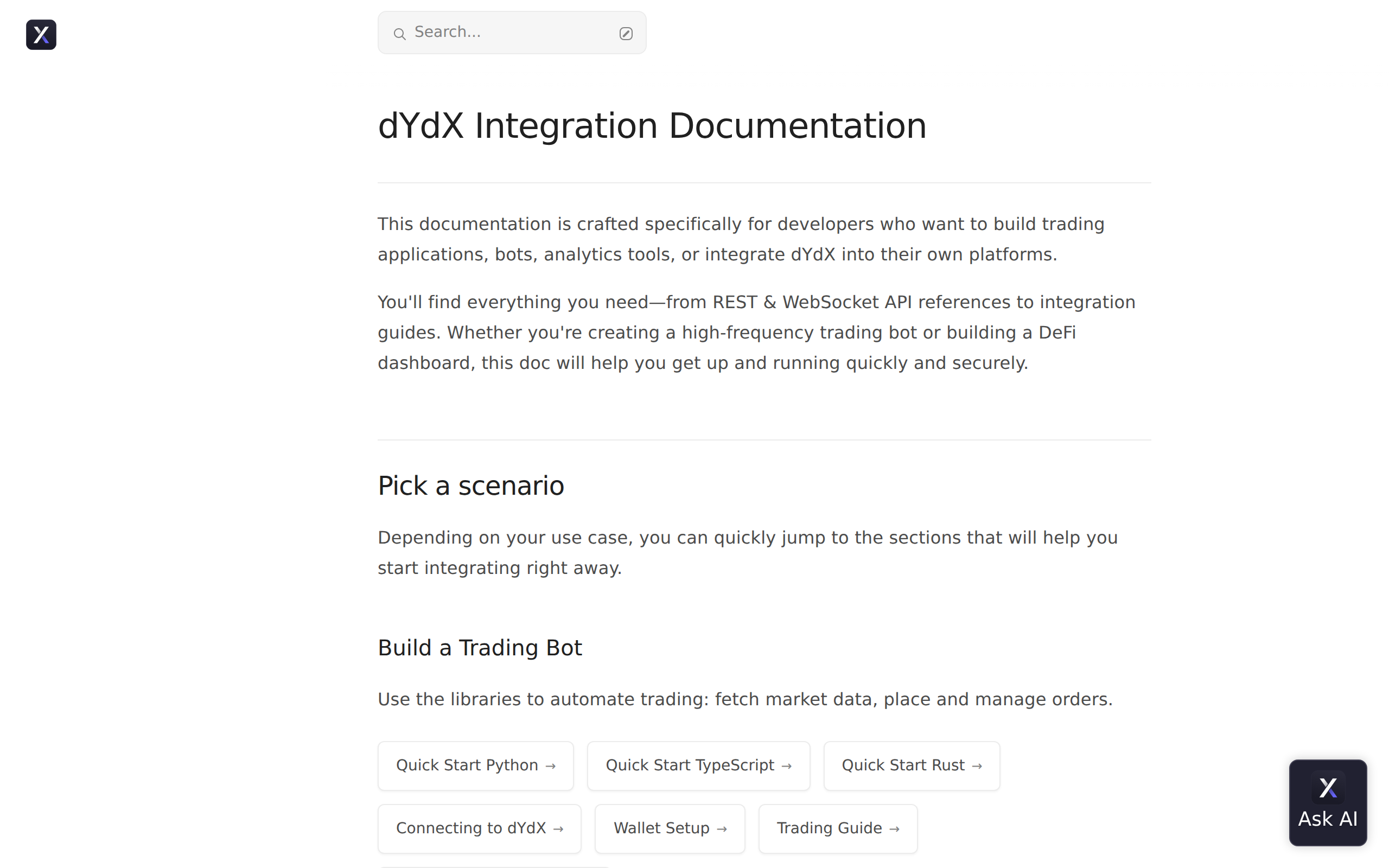
For builders the picture is better. The API reference and integration guides are well organized, which is a reason bot developers stay.
Verdict
dYdX still makes sense in three cases: you trade mainly BTC and ETH, you want to stake DYDX and cut fees, or you value the validator-set argument over raw volume. It does not make sense if you want the deepest book, the lowest fee at small size, or a gentle start.
For most traders choosing a perp DEX in 2026, Hyperliquid is the first stop and dYdX the second. Neither is for beginners, and leverage can end an account in minutes. This is not financial advice.
Specifications
- Product
- Perpetual futures only, no spot or fiat
- Entry fee
- 5.0 bps taker, 1.0 bps maker (under $1M)
- Top tier fee
- 2.5 bps taker, -1.1 bps maker (over $200M)
- Staking discount
- 25% at 3,000 DYDX, 50% at 20,000 DYDX (tier 1)
- Margin asset
- USDC only
- Markets listed
- 118 on the markets page when we looked
- Max leverage
- Up to 25x on some markets (Coin Bureau)
- Order types
- Market, limit, stop-limit, take-profit
- Custody
- Self-custody wallet on the dYdX chain
- Restricted
- US users on official interfaces
As published by dYdX Trading Inc. and the dYdX community when we tested it.