1inch Review: The Aggregator Saves Real Money on Large Swaps and Little on Small Ones
1inch charges no protocol fee and splits trades across 400+ liquidity sources. Reviewers put the saving over Uniswap at 0.5% to 2% on swaps above $1,000, and close to nothing below.
The verdict
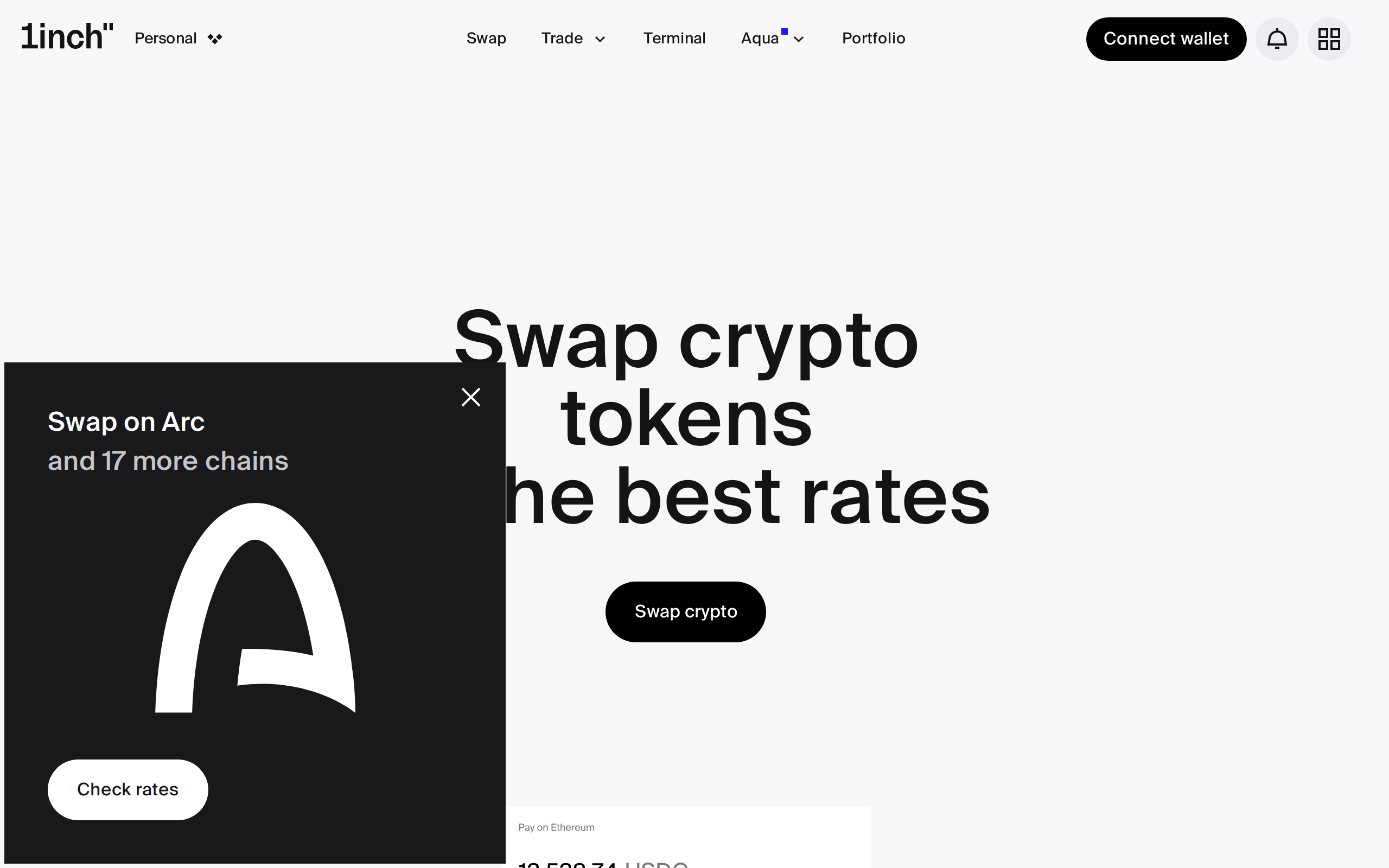
1inch is worth using for swaps above roughly $1,000 or in thin pairs, where splitting a trade across pools can save 0.5% to 2% against a single venue, according to comparison reviews. For small swaps of major tokens the gain is close to zero and gas can swamp it. Its contracts are non-upgradable, but a 2025 exploit on the old Fusion v1 resolver cost about $5 million, so watch for such incidents.
Best for Self-custody traders making larger or less liquid swaps across chains
Pros
- No protocol fee on the swap itself, only pool and network fees
- Pathfinder splits an order across many pools to cut price impact
- Fusion mode can protect from sandwich attacks and trim gas on Ethereum
- Non-upgradable contracts remove admin keys from core logic
- Covers 18+ networks, plus a limit-order terminal
Cons
- On swaps under $1,000 the saving over Uniswap is usually small
- Network fees apply on every route and can exceed the savings on Ethereum
- A March 2025 exploit of Fusion v1 resolvers drained about $5 million
- Savings figures in marketing and comparison pieces are vendor-flattering, not audited
- It does not remove token-scam or approval risk, which sit with you
Does 1inch beat swapping straight on Uniswap? Sometimes by a lot, often by a rounding error, and the line between the two depends on how big your trade is. Everything else in this review hangs on that.
What an aggregator does
A single exchange can only offer you the price in its own pools. An aggregator asks many of them at once. 1inch's routing engine, Pathfinder, searches more than 400 liquidity sources and can split one order across several, so that no single pool takes all the price impact. Coin Bureau and others describe a typical route as part Uniswap, part Curve, part Balancer and a small remainder elsewhere.
That is why large orders benefit. Price impact grows faster than the size of the trade in a single pool, so splitting it flattens the curve. For a $50 swap of ETH to USDC, the best pool is already deep enough, and splitting only adds steps.
What the saving looks like in numbers
Levex's comparison puts the gain at 0.5% to 2% on swaps above $1,000, and says that below $1,000 going direct is often quicker with minimal price difference. We read that as a fair range. Be wary of larger claims: one tutorial cited a 78% cost saving in a single test, which tells you about that trade on that day and little about yours.
On a $5,000 swap, 0.5% is $25 and 2% is $100. Set that against gas. On Ethereum mainnet, a routed swap touching several pools can cost more in gas than a one-pool swap, so a $25 gain can vanish. On a cheap network such as Base or an L2, gas is small and the saving stays whole.
Also remember that Uniswap's own interface routes across its versions and has built order-flow auctions of its own, so the gap you measure against the app can be narrower than against a bare pool.
Fees, and what you actually pay
1inch takes no protocol fee on a swap, per Coin Bureau's review and other sources. You pay the pool fee, which runs from about 0.05% to 0.3% on most routes, plus the network fee. Check the quote screen before you sign, because wallet and interface fees can differ by product.
Fusion mode changes the shape of the cost. A resolver fills your order and pays the gas, and the price already includes it. One review claims this cuts gas by 30% to 50% on Ethereum, but we could not verify the range and it will move with network conditions. Fusion also helps against sandwich attacks, where a bot places orders around yours.
The limit-order terminal
The Terminal page is for readers who want more than a swap box.
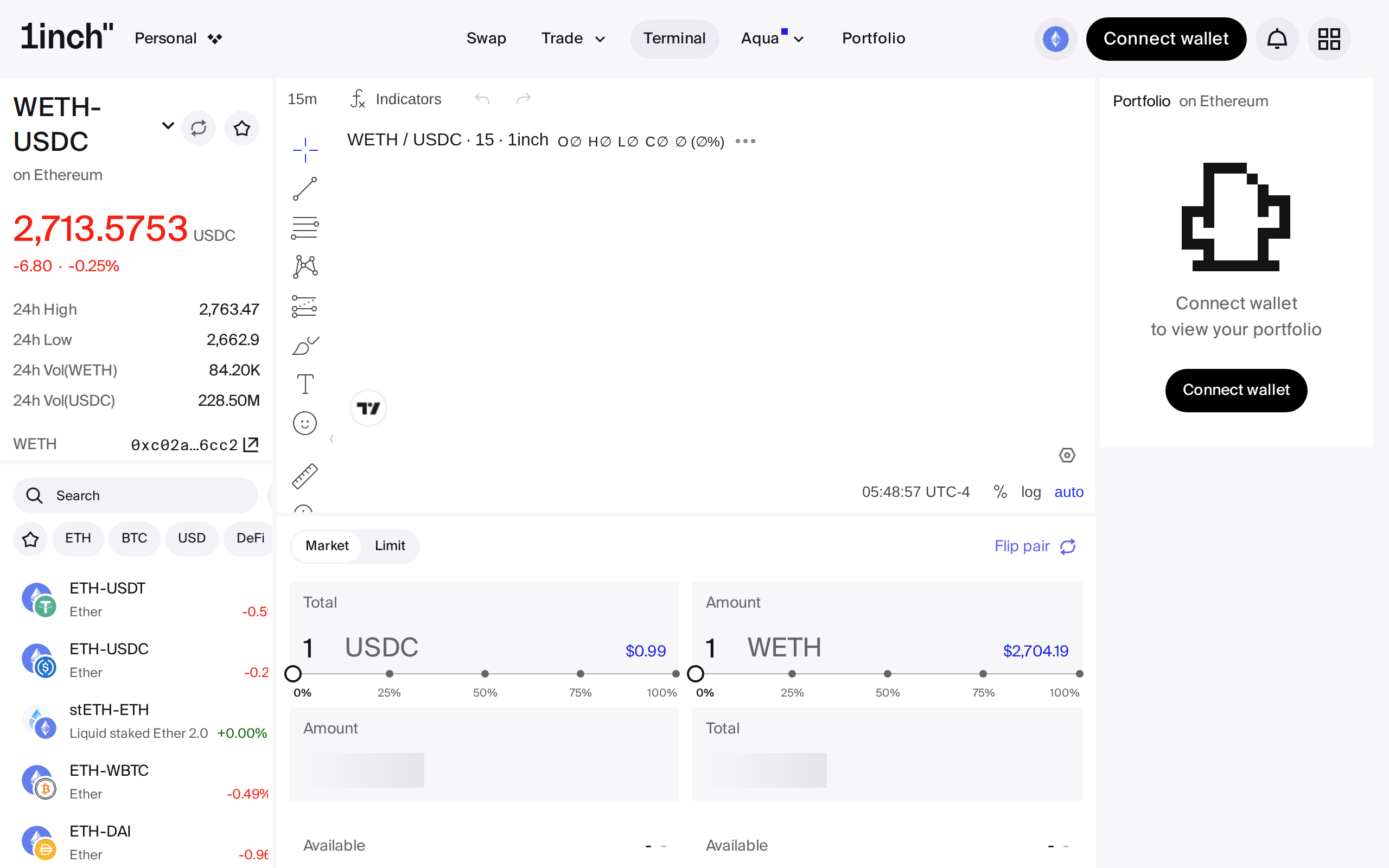
It offers limit orders and a trading layout, which turns the aggregator into something closer to an exchange screen. Limit orders are useful when you want a specific price and do not want to watch a chart. They add no custody risk, because your funds stay in your wallet until a fill.
Safety, and the 2025 exploit
The security page lists non-upgradable contracts with no admin keys, MEV protection through private routing, scam-token detection and ISO 27001 and SOC 2 Type II certification. Those are claims from the company, so treat them as claims.
The record is not spotless. In March 2025, an attacker drained about $5 million from resolvers using the older Fusion v1 contracts by exploiting a calldata bug, as Cointelegraph reported. The attacker later returned the funds and kept a bounty of about $450,000. The flaw sat in resolver contracts rather than in users' wallets, and the money was recovered, but two years of undetected risk in old code is a lesson. Old contracts age badly, and so do old token approvals.
Beyond swaps
1inch also runs a card, branded with Crypto Life, and a learning hub.
The Learn guides are a good place for beginners to understand slippage and approvals before the first trade. The card page promises a way to pay with crypto and borrow against it.
We have not tested the card, and any product that borrows against your holdings carries liquidation risk. We would judge it separately.
Who should use it
Use 1inch if you swap above about $1,000, trade thinner tokens, or work across several chains. Compare its quote with the other tool for a few real trades, and keep a note of the net amount received after gas, not the headline rate.
Stay on the simplest route for small swaps of major coins. Revoke old approvals, verify every token address, and never treat a good quote as a safe token. Nothing here is advice to trade any asset.
Specifications
- Fee
- 0% protocol fee, pool and network fees apply
- Liquidity sources
- 400+ across DEXs
- Networks
- 18+, per the swap page
- Routing engine
- Pathfinder, splits trades across pools
- MEV protection
- Fusion mode and Rabbithole private routing
- Order types
- Market swaps and limit orders (Terminal)
- Contracts
- Non-upgradable, no admin keys
- Certifications
- ISO 27001 and SOC 2 Type II, claimed
As published by 1inch when we tested it.